Showing posts with label history. Show all posts

27 August 2012

Old Photographs of Qing Dynasty Women


Photo: Library of Congress

Yohani Kamarudin and Michele Collet at Environmental Graffiti have composed a collection of photographs of Chinese women in the 19th century, documenting the impact of foot-binding and Manchu influence.

In the words of Yohani,
"At home or abroad, in holiday robes or in plain clothing, the heart of a Chinese female seems to be at all times ready to overflow with mirth and good humor.” This description comes from a Western observer’s account of life in China, and the character of its people, during the 19th century. Its focus: the painful process of foot binding. 
Such a quote may suggest a positive take on womanhood during the 1800s, and the account positions itself as compassionate towards those it describes. However, the author presumes to see women as the helpless victims of Chinese males and Confucianism in general. He has a clear bias against many of the cultural practices observed by the women he seems to praise. 
Westerners' letters and stories from this era appear to paint a rather negative picture of life for Chinese women. Many of those who wrote them were, after all, missionaries, doubtless hoping to convince others of the necessity of ‘saving’ these women from the perceived barbaric practices of their culture. 
Looking back at Chinese culture with the eyes of people living in a completely different time, it’s hard to know exactly what life would have been like for women during those years. However, perhaps by examining these vintage photographs, we can gain a glimmer of insight.
See the entire gallery here, as well as the one on foot-binding here.

I thought she had iPod headphones on at first.

10 October 2011

Here's to 100 Years!

Note: If you are new here, read this then this, first. You can also contact me, KaiWen, here. 

UPDATE: Epic failure on my part. I erroneously posted this on new years last year. Last year was the 99th birthday of the ROC, not the 100th. Also, although the Republic of China was officially founded on New Years Day 1912, but its birthday is celebrated on October 10th, the day of the Wuchang uprising and the beginning of the Xinhai Revolution. Today, October 10th, 2011 marks the 100th anniversary of the founding of the Republic of China. Our friends at NMA can give us a little history lesson.


Today marks a very special day. Because today marks a great anniversary. Today marks the 100th Anniversary of the founding of the Republic of China. 100 years ago today, Sun Yi Xian and Kuomintang Nationalists overthrew the Qing Empire and established the Chinese Republic. In the face of three bloody wars, Japanese Imperialists and Communist threats, the Republic of China has come out strong; as a new democracy and one of the Asian Tigers. Here's to 100 more years!


The Hong Kong World Financial Center totally stole the idea of launching fireworks from a building. Above is Taipei 101, the second tallest building in the world (taller than any in Mainland China), and the worlds first skyscraper fireworks display. Enjoy and Happy New Year (until February)!


16 June 2011

Extraordinary Fidelity

Movie Time!

The CIA, yes the CIA, has released a documentary called "Extraordinary Fidelity". It tells the story of John T. Downey and Richard Fecteau, who were two CIA agents shot down over Manchuria during the Korean War. Their mission was to extract a Chinese agent who was organizing a guerilla rebellion to take down Mao's government. The two were captured and imprisoned for 20 years.

The film wasn't originally intended for the general public, but as a video for new recruits to help them learn about the agency's history. But now its coming to a YouTube link near you! (or embedded here)

13 June 2011

Things Mexico Stole from China: Piñatas

See Here
OK not exactly. What I meant to say was that the Piñata may have been developed independently in both Meso-America and China. Piñatas were created in Meso-America in pre-columbian times out of clay pots in the shape of their gods that would be swung at with sticks until they broke, releasing pastries symbolizing their god showering them with wealth. But it is also believed that it could have also come about in China. During the Spring Festival (Chinese New Year) Marco Polo's diaries described them as hanging paper figures in the shape of oxen or other animals (probably according to the zodiac) which would be struck by Mandarins, releasing seeds. The "pinata" would then be burned and the ashes gathered for good luck. However I would be skeptical, as there are no oral or written records (that I know of) that document this practice, and the Chinese were very good at writing their history down.

09 May 2011

Torture in Ancient China


Torture has been practiced by nearly every civilization at some point. It is mostly used as a punishment for a crime or to extract information or a confession. In Ancient China (2100 BCE - 200 BCE) torture was frequently practiced.

Some of the best recored torture practices were known as the Five Punishments, used in ancient China up until the Han Dynasty. They are divided into 3 categories; Five Punishments for Slaves, Five Punishments for Serfs, and Five Punishments for women. Most of these punishments could be remitted by paying a fine.


Five Punishments for Slaves


Qíng (黥) meaning tattooing or branding. The offender would be tattooed on the face as a mark for their crimes.

Yì (劓) meaning to cut off the nose. Obviously this would cause you horrible disfigurement.


Yuè (刖) meaning to cut off one or both of the feet. This would greatly hinder your ability to work and provide for your family.

Gōng (宫) today known as Yāngē (阉割) or castration. I have a whole post dedicated to this here.

*Dà Pì (大辟) lit. "Great Provision", the death penalty.


Five Punishments for Serfs


Chī (笞) Caning. The more severe the crime, the more lashes.

Zhang (杖) The same as Chī, but with a larger stick.

Tú (徒) Slavery or Penal servitude for a given period. I guess the equivalent would be "community service"

Liú (流) Exile. The more severe the crime, the more remote and farther away the exile location.

*Sĭ (死) Death


Five Punishments for Women

Xíngchōng (刑舂) The offender was forced to grind grain. So in other words, a typical day for a women in ancient China.


Zǎnxǐng (拶刑) To crush the fingers slowly.

Zhàngxing (杖刑) To beat with a wooden plank.

Cìsǐ (赐死) The gift of death, permission to commit suicide. (I don't get it either)

Gongxing (宫刑) Although it had the same name, Gong for women was solitary confinement rather than castration.


*Execution was carried out in various ways depending on the time period, including boiling, quartering, decapitation, strangulation and two very unique methods described below.


One famous form of torture/execution was by bamboo. In World War II and Vietnam, the Japanese and Vietnamese would force strips of bamboo under POW's fingernails which I imagine hurt like hell. But in ancient China bamboo was used in a different way. The victim was suspended over a bamboo shoot, and since bamboo grows so fast, the shoot would grow into and out of the victims torso over several days, causing a slow and painful death. It was even featured on Mythbusters.


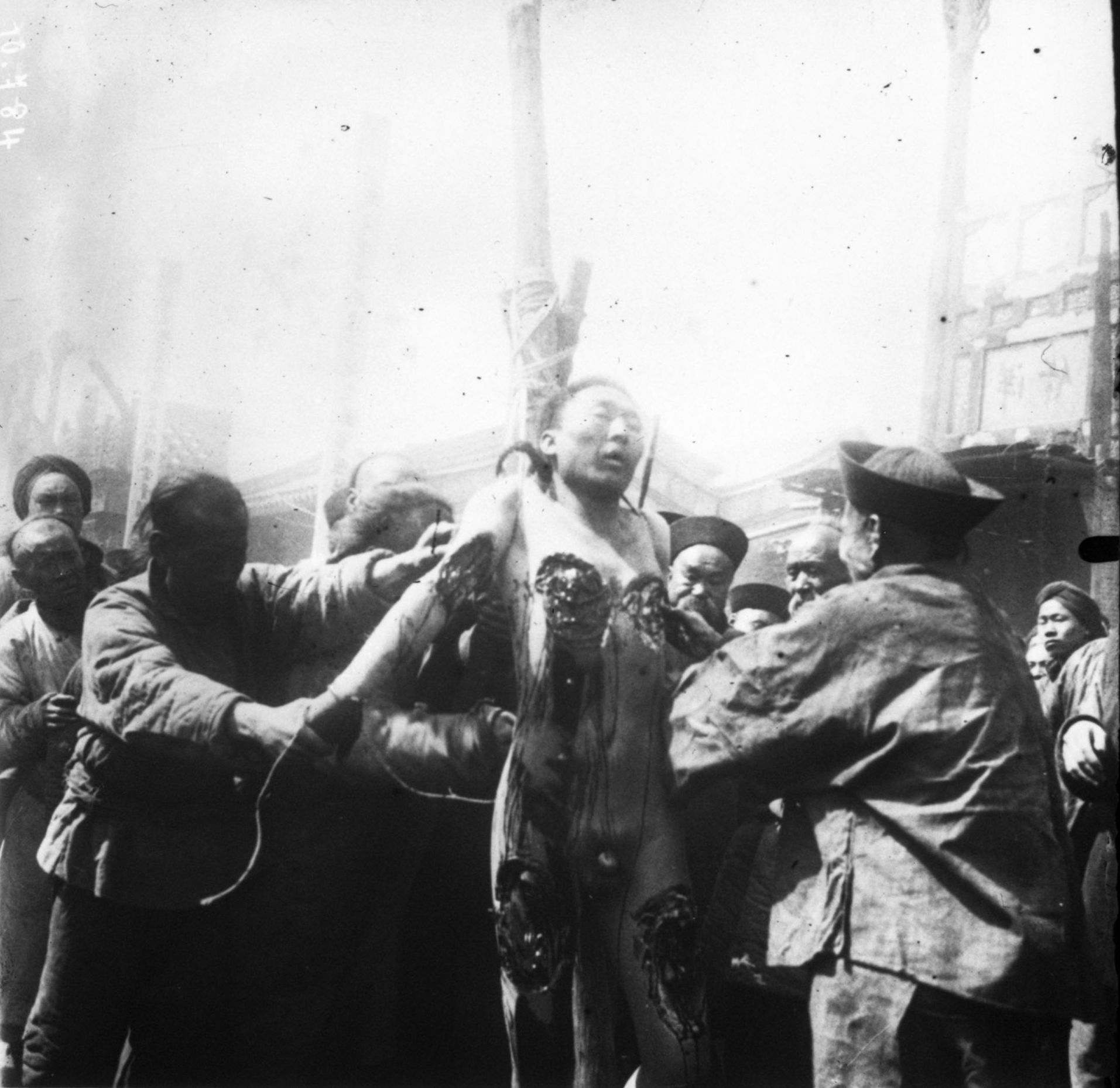
Another famous practice was that of 殺千刀 (Shā qiān dāo) or "death by a thousand cuts". It was practiced from the Tang Dynasty until the fall of the Qing in the early 20th century. As the name implies, it involves slowly slicing into different parts of the victims body until they died. This punishment was seen as disgraceful to the victim because mutilating ones body was against Confucian ideals.

13 April 2011

Things Japan Stole from China: Bonsai

It’s widely known that Japanese culture was greatly influenced by the Chinese; however there are many things that people accredit to the Japanese with but were actually created in China. In this series, I look into these misattributed creations and why they got that way.

A Bonsai tree

Bonsai is the art of miniaturizing trees, growing them and caring for them for aesthetic purposes. Bonsai trees are a common sight in any Japanese garden. They are also popular in homes and among horticulturists. Bonsai emerged in Japan in the 1300's and slowly grew more popular over time. Eventually they had become ubiquitous throughout Japan. But the story goes much deeper than that. Bonsai comes directly from the Chinese art of Penjing (盆景) literally "tray scenery". While bonsai focused mostly on the tree, Penjing was centered around creating entire miniature landscapes in a tray. They could be as complex as a mountain range or as simple as a single tree. Penjing is over 7000 years old. Its origins emerged in primitive form in prehistoric China in Yangshao culture. Primitive trays called "pen" were frequently constructed in early China. They were used for things such as incense burners, water dishes and vessels used for rituals. These would eventually be used in Penjing. Over time they were made of other materials such as wood or stones with moss. By the first century CE, Taoism and Buddhism had taken a strong root in China. In Taoist mythology, those in line with the Tao had the power shrink whole landscapes to a small size. Many Taoists tried to emulate this power, and thus the art of Penjing was created. From the Tang Dynasty onward, Penjing became a widely praised and respected art form. Trees with knots and unusual shapes were the most sought after, because it was believed that they were bestowed with unique energy. Bonsai was brought to Japan as souvenirs by Japanese diplomats to China in the 6th century. The art slowly took root from there.

A Penjing, encompassing a larger landscape

16 February 2011

Kai Tak

No I've not gone to Hong Kong, it's much too far away for a week off work since it takes a whole day just to get there when you consider the time differences as well. Plus a lot of airlines are flying much slower to save gas.

I remember Kai Tak with great amounts of glee as you could watch airplanes land from where I used to stay in Kowloon as a young child. Granted it is no St Marteen.


But you could reach up from a tall Kowloon building and nearly touch the aircraft.


Of course it was scarier when you were actually inside one of those 747s as you swear with night landings you could see televisions and people eating noodles inside their flats from the air plane windows.


On a related note:

Why was Hong Kong Kai Tak Airport closed? (asked elsewhere)

  • It was full. ALL of the landing and take off slots were full up, so it was filled to capacity this strangled trade and tourism.
  • It was dangerous, the Kai Tak landing required special training to land due to the mountains around HK look at videos on youtube. Even taking off was iffy as the end of the runway was sinking, you would hear the engines splutter on take off due to water splashing into the engines it was that bad.
  • As part of #2 with Kai Tak gone Kowloon land was freed up. With Kai Tak nothing on the approach to Kai Tak could be built more than 14 stories high. Once the landing flight path was gone buildings could pop up at any number of floors.
  • Kaitak's land itself was also freed up for residential buildings to ease the uber overcrowding of HK.
  • Pork barrelling. The HK economy was great in the 1980s and 1990s, they simply could not take the money away as the PRC and HK people would hate them for this. So the colonial government built a massive airport bring in expensive British contractors to do much of the work. Therefore funnelling much of the surpluses of HK into British pockets.

31 October 2010

China total war!

Nigh on ten years ago I wrote a guide for Shogun total war, then wrote something else for Medieval total war too. 3 years ago I got paid for it even though it wasn't the original intent but always thought hmm wouldn't it be utterly awesome to have China total war too?

And lo and behold a decade later some clever so and so's have made a three kingdoms mod for total war... work and lack of time means I don't really have the patience for total war games anymore. It was probably the pope being an asshat in MTW who kept on excommunicating me over and over it was worse in MTW2.

Here is a video


This is the link to the project home page here

01 October 2010

October 1st

March 29, 1975

I have since my formative years followed Dr. Sun Yat-sen, our Founding Father, in carrying out the National Revolution. I have at all times considered myself a disciple of Jesus Christ and a follower of Dr. Sun Yat-sen. There has not been a day in which I did not struggle with perseverance to remove obstacles to the fulfillment of the Three Principles of the People and to establish a democratic and constitutional nation. For the last twenty years and more, out bastion of freedom has become ever sounder and stronger and we have incessantly conducted political warfare against the evils of Communism of the Chinese mainland. Knowing that out great undertakings against Communist and for national recovery are steadily gaining in momentum, civilians and soldiers of the nation and comrades of the party should never be so overcome by my passing as to lose their combat determination. I earnestly hope that you will wholeheartedly unite as one, follow of command of the party and government, consider the three principles as your spiritual leader and make national recovery your common goal. Comrades and compatriots! If you do so, my spirit will always be with you. My lifelong goals have been to realize the Three Principles, recover the mainland, rejuvenate our national culture and remain in the democratic camp. These goals also express the revolutionary aims and combat determination of all our compatriots at home and abroad, civilian and military alike. I hope you will persevere in the fall of all adversities and brace yourself for the great tasks ahead. Never stop until you have carried our your responsibilities for National Revolution! Be diligent and courageous. Do not be insolent and neglect your duty!

- Chiang Kai-Shek

30 September 2010

Chinatown from your Desktop


The Huffington Post has posted a photographic walkthrough of China's American colony (also known as San Francisco Chinatown). More than 50+ photographs give one a detailed look at the beauty of the oldest Chinese community in the America's, from the comfort of your computer.

Enjoy!


27 September 2010

Kowloon Walled city

Demolished in 93-94 It was a functioning anarchic state, with only two laws, nothing higher than 14 stories and electricity only to prevent fires. Its a fine example of how when people say society has to be like this and that they are wrong. Some of my family actually lay claim to living in the Walled city in the 1960s and 1970s.

Today the ghosts of walled city are in Sham Shui Po district and also the big Mansions on Nathan Road Chungking and Mirador mansions. With an incredible population density of 1,255,000/km2
You can read more about it at the following links

Wikpedia
109 we come from the future
Archdose


No subs.


Oddly I feel since society is quickly becoming M shaped where there is an increasing divide between those who have and those who do not that this sort of thing in China at least (where the land is hoovered up by the parasite middle class rentiers). The Hong Kong, Zuhai and Guangzhou sprawl is starting to look and feel an awful lot like the sprawl depicted in William Gibson's Sprawl trilogy

17 September 2010

Say No to Mandarin!

There is a war of words occurring in China. Literally. Since the PRC’s founding, the communist party has been pushing the country to adopt Putonghua (common speech) as a way to promote national unity. Putonghua is the establishment of adopting Beijing Mandarin as a lingua franca for all Chinese. While over 53% of Chinese already speak Mandarin natively, half of 1.3 billion people is still a lot. As a way to push Putonghua, the PRC government has banned using any dialect other than Mandarin in all television broadcasts, with the exception of Cantonese and Wu (Shanghainese) as they are the largest of the minority dialects. Non-Mandarin dialects are also discouraged in the public education system. Students can have their grades penalized for using Cantonese or other dialects.


Recently, the people of Guangzhou took to the streets under rumors that their TV broadcasts would mandate Mandarin. Many feel that the government is trying to replace all other dialects with Mandarin and that it will lead to a loss of identity.


While I agree that a national language is crucial for a strong unified nation, a national dialect is a little more of a hairy issue. In a country as vast and diverse as China, it becomes even more complex. In Imperial China, people rarely ventured far from their home villages (except for the Beijing bureaucrats). This resulted in thousands of dialects in different pockets all over China. It wasn’t unusual for the town over the mountain to speak another dialect. Ever since the Ming Dynasty, the government has tried to implement Beijing Mandarin as a national dialect. From then to the present day, it has been mostly successful. 53% of China speaks some accent of Mandarin but it took over 700 years. In the southeast of China, the mountainous terrain had isolated most communities from these national language efforts until modern times. As a result, lands from Shanghai to Guangxi still hold on to these pocket dialects, and they have firmly resisted Putonghua.

14 September 2010

Links Day!

My entire bookmark folder is full of these interesting sites that I just have to share. If you read this blog you may find many of them relevant to your interests.


China Hush

This is the ultimate blog/website for the most popular news stories in China all translated into English.


Angry Asian Man

Personally I foresee him as some butthurt basement dweller who’s sworn duty is to blog and report every little misfortune that falls upon Asian Americans (no matter how small). A popular white comedian makes an asian joke? You will hear about it first on AngryAsianMan! Although you have to give him credit for all the research he does and he sometimes has very interesting posts.


Asian Nation

A beautifully created website by a Vietnamese American Sociology Professor that tells you everything about every culture in the Asian American community, as well as their history, the challenges they face, even detailed demographics.


All Look The Same

An interesting blog with a test you can take to see if its true that all asians look alike. The test gives you photos of Chinese, Japanese, and Korean’s and you have to decide which ethnicity they are. The results may surprise you. There is also tests for things like architecture and food.


Ask A Korean

[Obligatory]


Speaking of China

A [white] women who blogs about issues in China and also has a segment “Ask the Yangxifu” (a foreign wife of a Chinese man) where she answers questions about relationships between Chinese and non-Chinese. It seems like TCG has competition.


CulturalChina.com

An information site that can tell you everything there is to know about China. It has hundreds of articles on history, culture, people, literature, issues, cuisine, architecture and travel.


Pop Up Chinese

A free online language learning resource for Mandarin Chinese. I find this site to be incredibly useful. It includes many tools for helping one understand the language. If you want to learn Mandarin, this is a great place to start.


Pearl River Mart

See this post.


History-of-China.com

An simple website about the history of China. What makes it stand out is that it makes the history of one of the worlds oldest civilizations easy to understand and in plain English.


Our Orient

Yet another good website on China’s history and culture. The author also guides readers through many works of traditional Chinese literature and myths


True Tao

Your HTML based guide to Taoism.


The China Portal

Everything else


YouTube: Here are some of my favorite YouTuber’s who do videos on things Chinese/Asian. Some do it for fun and some discuss serious topics.


Icgator321

Essentially the female version of me (given I had the time and self-confidence to make YouTube videos).


ItsBigBang

A Chinese American Guy who pokes fun at his heritage for comedic purposes. Many of his videos will leave you saying “WTF!?”


Mychonny

Similar to itsBigBang, though much more insane.


KevJumba

One of YouTube’s most popular users. It isn’t really much about him that puts him on this list, as it is his co-star, his dad.


Icysparks2007

Now this I find puzzling. He makes videos discussing AMWF relationships (Asian Male-White Female) which is obviously a rare coupling. If you go to YouTube and look up AMWF, countless videos show up. While if you search for the more common AFWM, only 2 or 3 videos come up. But Im not going to go into this.

05 September 2010

China and Nuclear Weapons


It appears there is some misconception on the status on nuclear weapons in China. Id thought I should clean things up.


China’s nuclear weapons program began shortly after the PRC’s founding. Mao Zedong believed China would never be taken seriously without nuclear warheads, and that they would be under constant “nuclear blackmail” from the US. With the help of the Soviet Union, China built its first nuclear reactors. They also relied on the Soviets for nuclear materials such as yellowcake. After the Sino-Soviet split in the early 1960’s, China had lost its assistance from the USSR, but was determined to “break the west’s monopoly on nuclear weapons”. On October 16, 1964 China detonated its first atomic bomb, code named ‘596’, in Lop Nur. Within a few years, they tested their first hydrogen bomb and created warheads for ICBM’s.


Today, China is one of the five recognized nuclear powers. Its current stockpile is believed to be about 250 warheads. For comparison, the UK has just over 200, France about 350, the US has over 10,000 and Russia has almost 12,000 (enough to destroy the earth ten times over).


China has signed and ratified the Nuclear Non-Proliferation Treaty and the Comprehensive Test Ban Treaty. China is also the only nuclear state with a ‘no first use’ policy, meaning they promise not to use nuclear weapons against any country unless nuclear weapons are used on China first. As seen in my very first post, China has ICBM’s that can carry warheads anywhere in the world except South America.


The ROC/Taiwan currently does not possess nuclear weapons. However in 1967, shortly after China’s hydrogen bomb test, the ROC began a secret nuclear weapons program. Out of the facade of creating energy, Taiwan was able to acquire nuclear materials from the US and Canada. By the 1970’s Taiwan was able to produce weapons grade plutonium in large enough quantities for a bomb. But the US soon found out about the program and pressured Taiwan to dismantle it in 1976.


There is currently no intelligence of Taiwan possessing a bomb, yet they do have the resources to construct one. The PRC has stated that possession of nuclear weapons by the ROC would be grounds for immediate military action. With that kind of threat breathing down their necks, I highly doubt the ROC would risk having a secret nuclear weapons program.


And now for some delicious footage.


Apparently this is from Trinity and Beyond a documentary on the atomic bomb. I have no idea if actual footage of the test exists. If this is real you can easily see the huge propaganda aspect of it.

03 September 2010

They Say History Repeats Itself

Most readers of this blog are probably aware of the history of Taiwan and its role in the Chinese civil war. As Chang Kai-shek and the Nationalist Army lost more and more ground to the Communists, they retreated to the island of Taiwan where the government of the ROC rests to this day. Since then, it has been sort of a cold war over the Taiwan strait.


But what if I told you that almost the exact same thing happened 400 years ago? Well it did. In 1661 Zheng Chenggong or “Koxinga” a loyalist to the Ming Dynasty and Arch Commander of the Ming Army, wanted to do whatever necessary to resist the Manchu invaders that would later establish the Qing Dynasty. Even after the Manchu took Beijing, the Ming Emperor retreated to Fuzhou. However, his army was unable to resist the Qing forces, he was captured and executed in 1646. The last member of the Ming Imperial family, Zhu Youlang had fled to the southwest. Koxinga and the remaining Ming troops were cornered in Fujian Province and unable to help Zhu. By 1661, the Ming Emperor sought asylum in Burma. At first the Burmese king gave him refuge, but after numerous threats from the Qing, he was rejected and eventually killed by Qing forces. Meanwhile, Kongxia, seeing defeat as inevitable, evacuated his forces and other Ming loyalists to Formosa (Taiwan). At the time, Taiwan was under control of the Dutch East India Company. Despite being in the face of westerners, Koxinga was quickly able to annex the island as it was nothing more than a trading post with few military personal. After booting the Dutch from the island, he established the Kingdom of Dongning with the goal of reorganizing his forces to eventually recapture the mainland.


Chiang Kai-shek Kongxia died in 1662 of malaria. His son Jing then took over as leader. Jing had attempted several times to launch an assault on Fujian but failed miserably. He entered a depression, indulging in liquor and women until his death. After his death, the generals debated his successor, but eventually Zheng Keshuang took the throne. After losing the island of Penghu to a Qing invasion, Keshuang surrendered Taiwan to Qing rule.


The similarities are startling aren’t they? Koxinga is revered as a hero in Mainland China because he ousted the Dutch “imperialists” and brought the island into Chinese rule. He is also regarded by the Kuomintang as a patriot who went to every last length to protect the Ming throne and repel the invading Qing. They also frequently compare him to Chiang Kai-shek. There is also a shrine dedicated to him in Tainan city.


If history does indeed repeat itself, it is only a matter of time before Taiwan is annexed by the PRC. However, Koxinga did not have the potential backing of a military power (The United States) to act as a significant deterrent. Then again, it is a rule of thumb in Chinese history that eventually a dynasty loses the Mandate of Heaven and comes to an end. And eventually, the Communist dynasty (or as I call it the ‘Mao’ Dynasty) will also come to an end like all those before it.


18 August 2010

China’s Lost Kingdom: The Xia Dynasty


Historian’s widely agree the the earliest civilization in China was the Shang Dynasty, founded in 1600 BC. This is as far as written records go, as evidenced by oracle bone scripts that have been found. However there is some debate as to weather the Shang is truly where it starts. According to Chinese tradition, the first Kingdom after the reign of the three sovereigns was the Xia Dynasty, supposedly founded after the death of the last sovereign in 2070 BC. The existence of the Xia Dynasty is debated because there is no reliable written records, only legends mostly passed down from word of mouth. However there is archeological evidence of tombs, bronze instruments and building foundations that have been carbon dated between 2100 and 1800 BC. Falling precisely into the supposed period of the Xia.


In 1996, the Chinese government commissioned the Xia-Shang-Zhou Chronology Project, to determine the linage between China’s prehistory and the unifying Qin Dynasty. The project concluded the last pre-civilization society of the Huang He river valley was Longshan culture. A primitive, tribal, neolithic society. It was then however the three sovereigns and the five emperors came about and ruled the first Chinese civilization. Keep note the three sovereigns is mythological and not based in historical fact. Historical evidence says in late Longshan times, two tribes, the Xia and the Chiyou were at war where the Xia prevailed and began a small kingdom in the Huang He river valley. It is then when the three sovereigns and the five emperors came to rule. The story of the Xia Dynasty begins during the reign of a king named ‘Yao’ the second to last of the five emperors.


Legend has that “Yao” appointed “Gun”, an engineer, to stop a series of terrible floods that have always plagued the Huang He river valley. After nine years of continuous failure, the new king “Shun”, last of the five emperors, ordered Gun to be executed for his failures. Gun had a son ‘Yu’. Yu was highly trusted by Emperor Shun. So Shun appointed him to finish his father’s work which was to make the flooding stop. Yu’s method was different from his father’s; he united all the people of every tribe and ordered them to help him build canals in all the major rivers that were flooding and lead it out to the sea. He did this for 13 years, without going back to his home village. Legend says in those 13 years, he passed by his house three times without going in which is a sign of his perseverance in his work. The people who noticed him praised his perseverance and were so inspired by him that other tribes joined in his work as well. In the end, after 13 years, he was successful in stopping the floods and was greatly praised by his people.


Yu’s unification of the tribes in the goal of stopping the floods made him a legend, and was named Emperor of the new Xia Kingdom of China. The Xia Kingdom was the first Chinese society to have a unified army, mass irrigation for crops, and the use of many Bronze tools.


On another note, thanks to all of our readers for 20,000 hits!


25 July 2010

When the Chinese discovered America


You may have learned in elementary school that Christopher Columbus discovered America.


LIES!!!


Four things:


  1. He landed in Cuba or the Bahamas, not the modern day US
  2. The Native Americans were already there
  3. He didn’t discover America, he brought it to Europe’s attention. Historian’s agree that Leif Ericson and his viking pillagers landed in Newfoundland in 1000 AD. 500 years before Columbus.
  4. All of that is irrelevant, as it may have been China to first see the shores of America


In 499 AD, a Buddhist missionary by the name of Hui Shen sought the land of Fusang. In Chinese mythology, Fusang is a divine tree on the eastern horizon where the sun rises. At this tree is supposedly the elixir of life.


Hui wanted to bring new converts into Buddhism in this land, so he sailed off on a journey east to find it. He sailed over 20,000 li before reaching land. Li is an imperial Chinese form of measurement equal to about 415 metres. Therefore, 20,000 li is equal to approximately 8,316 km. The distance between China and America is more or less 8,600 km, depending where he left and how on course he was. This would plant Hui in the pacific northwest of the modern US. His descriptions of the land were recorded in the Book of Liang, and only provides more evidence that were he landed was indeed America:


"Fusang (land of Jade Mulberry trees) is 20,000 li to the East of the country of Dàhàn (lit. 'Great Han'), and located to the east of China."

"On that land, there are many Fusang plants (perhaps red mulberry, native to North America) that produce oval-shaped leaves similar to paulownia and edible purplish-red fruits like pears. The place was rich in copper and traces of gold and silver but no iron. The native tribes in Fusang were civilized, living in well-organized communities. They produced paper from the bark of the Fusang plants for writing and produced cloth from the fibers of the bark, which they used for robes or wadding. Their houses or cabins were constructed with red mulberry wood. The fruits and young shoots of the plants were one of their food sources. They raised deer for meat and milk, just as the Chinese raised cattle at home, and produced cheese with deer milk. They traveled on horseback and transported their goods with carts or sledges pulled by horses, buffalo, or deer."

He describes the government of the lands peoples:


"An emperor, or a main chief, with the help of several officials, governed the country. The majority of people were law-abiding citizens. The country had no army or military defense but two jails, one in north and the other in south of the country. Those who had committed serious crimes were sent to the north and they stayed there for their entire lives. These inmates, however, could get married. If they got married and produced children, their sons became slaves and daughters remained as maids"


Their society:


"The marriage arrangement was relatively simple. If a boy wanted to marry a girl, he had to build a cabin next to the home of the girl and stay there for a year. If the girl liked him they would get married; otherwise he would be asked to go away…when a person died in the community his body would be cremated. The mourning period varied from seven days for the death of a parent to five days for a grandparent and three days for a brother or sister. During their mourning period they were not supposed to consume food, only water. They had no religion."


These descriptions seem to accurately portray Native American’s and the geography of North America. The story does have flaws though. Hui describes them as traveling on horseback, despite the fact horses are not native to the America’s and were not brought over until the European’s arrived. Also, it seems far fetched that one man could survive a sea voyage that long and far. Still, this is far more believable than other Chinese exploration theories.


According to the book, 1421: The Year China Discovered the World by Gavin Menzies, Chinese explorer Zheng He discovered America on one of his famous voyages. He also claims Zheng He found Australia, New Zealand, Antarctica and the Northeast Passage, but most records of these voyages were lost. Menzies wrote a second book, 1434: The Year a Magnificent Chinese Fleet Sailed to Italy and Ignited the Renaissance claiming Chinese influences started the renaissance.


Menzies bases these theories mostly on an 18th century map that is thought to be a copy of an earlier map from 1418. This map clearly shows the America’s and is labeled as such.


If the Chinese did discover America, weather it be Zheng He or Hui Shen, the world today may be a different place if they decided to stay.