Showing posts with label people. Show all posts

27 August 2012

Old Photographs of Qing Dynasty Women


Photo: Library of Congress

Yohani Kamarudin and Michele Collet at Environmental Graffiti have composed a collection of photographs of Chinese women in the 19th century, documenting the impact of foot-binding and Manchu influence.

In the words of Yohani,
"At home or abroad, in holiday robes or in plain clothing, the heart of a Chinese female seems to be at all times ready to overflow with mirth and good humor.” This description comes from a Western observer’s account of life in China, and the character of its people, during the 19th century. Its focus: the painful process of foot binding. 
Such a quote may suggest a positive take on womanhood during the 1800s, and the account positions itself as compassionate towards those it describes. However, the author presumes to see women as the helpless victims of Chinese males and Confucianism in general. He has a clear bias against many of the cultural practices observed by the women he seems to praise. 
Westerners' letters and stories from this era appear to paint a rather negative picture of life for Chinese women. Many of those who wrote them were, after all, missionaries, doubtless hoping to convince others of the necessity of ‘saving’ these women from the perceived barbaric practices of their culture. 
Looking back at Chinese culture with the eyes of people living in a completely different time, it’s hard to know exactly what life would have been like for women during those years. However, perhaps by examining these vintage photographs, we can gain a glimmer of insight.
See the entire gallery here, as well as the one on foot-binding here.

I thought she had iPod headphones on at first.

23 May 2011

We Chinese


I stumbled upon this interesting project via ChinaHush. Created by Scott Brauer, the project, known as "We Chinese" aims to document how modern Chinese feel about their country and where it is going. Well, heres their description:

We Chinese grew out of a curiosity to find out what Chinese people think about their country and their future. In 2010, I traveled throughout major urban centers in eastern China stopping people on the street to ask the same two questions about their country and their future. The respondents filled out a one-page typewritten questionnaire that included these two questions and some basic information including name, age, and occupation.
The questions were interpreted variously, and the responses range from prosaic to poetic, from rote to inspired, and from unemotional to patriotic. While it’s difficult to draw conclusions about the entire population, the people photographed here expressed a sincere love of country and optimism about the country’s future development and peaceful position in the world. I started the project as a way to respond to friends’, family’s, and strangers’ questions about the global direction of China and their stereotypes of the people. “Should we be scared of China?” or “Where is China headed?” or vague assertions about the collective character of billions of individuals that make up the country.
The project also comes from suspicions of my own methods in documentary work. My work imposes visual and written narratives on situations and cultures. By photographing anyone willing to be a part of the project, using the same set up for the portraits, and asking the same questions of all the subjects, I hoped a narrative about China and its people would emerge naturally.
There are hundreds of responses from people across China with many interesting responses. Check it out sometime.

07 March 2011

Oh TCG, you're so typical...

at least thats what National Geographic says according to world statistics. A study by National Geographic says that the typical human is a right handed, 28 year old Han Chinese male who lives in or near the city, is literate and works in the services industry.

Did I just blow your mind?


Even so, that composite image does not represent humanity as a whole. It was made from over 7000 Chinese men. The reason it was only Chinese men is because there are more Chinese men than the men of any other single ethnic group. While no ethnic group makes up the majority of all humans, Chinese outnumber any other individual ethnic group. If you wanted to see what the average human would look like all ethnic groups considered, it would probably look like the cover of TIME magazine Fall 1993:


Ok, America ≠ The World, but I don't think you can find a better example as the US is definitely the worlds most diverse nation.

26 January 2011

Amy Chua on Colbert


11 January 2011

Chinese Parenting


There seems to be a lot of buzz lately over a Wall Street Journal article by Amy Chua, "Why Chinese Mothers are Superior". She argues that the Chinese (Asian really) parenting technique of "tough love" makes children much more successful than the "just try your best" attitude of most western parents. She explains that Chinese mothers want their children to be the best because academic success reflects good parenting, and if your child wasn't perfect in school, it meant that you were imperfect parents thus causing you to lose face. It also has to do with the Confucian value of filial piety, that children should always respect their elders. She explains that Chinese children owe everything to their mothers for raising them, providing them with food, shelter etc. In return, their children must be the best children possible or they would bring disrespect to their elders.

Many western parents believe that pushing your child to be perfect is bad, and that scolding them for getting a B+ even though they tried their best (as Asian parents would do) is bad for their self esteem. Chinese parents don't take their child's feelings into account. They do whatever possible to make sure their children dont just try their best, but be the best, even if it means yelling at them for their flaws.

While Asian parenting may seem harsh, the numbers don't lie. Asian children rank consistently high in academics and test scores. Statistically speaking, Chinese parenting is superior, however pushing a child so hard can have other consequences. Asian countries have some of the worlds highest suicide rates. Many of them are committed by young adults because they don't feel like they are good enough due to their damaged self esteem or they simply snap under the pressure.

The western way of raising children won't make them score as high as the asian kids, but it will give them more confidence to want to try things they wouldn't normally do, were as asian kids won't want to venture too far from being a doctor or engineer, because that is the typical path their parents want them to  pursue.

I wouldn't raise my children the asian way, but I dont want to give them a free ride either. You should push your child, but not so hard that they fall over the edge.

10 January 2011

Video games


Hi chinese guy, nice blog you have here, i have a question. What age do Chinese men usually stop playing computer / video games? I just moved in with my boyfriend, a chinese man and he is 27 and he still plays computer games every night!
Thanks Sarah!!

Dear Sarah

Having a look at my Chinese contemporaries in both HK and the UK I'd say it varies, heavily. Generally as they are an escape from the usual drudgery of life. I mean what other artificial reality can we be superheros and or gun people down without consequences and lots of cost? Hell my day to day life isn't filled with thrills either. In Hong Kong many of my mates who work in office jobs stop by internet cafes have a few games of counter strike or something then go home. But they all tend to live alone in sardine can sized flats.

Myself I abandoned video games for nearly 5 years on account of having a very very low spec machine which couldn't handle anything more than pong. Also having to regularly study for my ACCA exams. A serious drag on my life I might add. I have dipped my finger back into games now and again but frankly I prefer to go out riding or be fixing something. I only really play when the weather is too bad outside. Which is why you see games mentioned here and there in my blog posts. IIRC Prototype and Stranglehold as well as Rome Total war three kingdoms.

However something I have seen is when they get married and or have children that they are simply too busy to play and therefore give it up. Though this is not exclusive to video games.

Kai was like this, he used to play a lot, then his wife had triplets. And he was busy looking after his three children to be playing. The usual things changing nappies, then having to take them to after school activities when they grew older.

Robbie was like this too, he was a fantastic motorbike rider and we'd tear up the back lanes regularly but when he married (without children) all of a sudden the bike and the gear was put away and he suddenly became sensible.

My dad was like this too, my dad apparently before my birth would regularly go out shooting when such things were legal in the UK. When I came along he had to curtail his hobbies considerably.

It might be to do with the fact that Chinese culture considers marriage to be a sign of maturity. Which is why the second you get married people left right and centre can and will extort you for those red packets of money at each and every opportunity. Peer/society and family pressure may put an end to it too

My point is it varies considerably and there is some causal relationship regarding general business and wasting time. Unless it is an addition or obsession whereby it is affecting his wider life. In terms of work, socialising, relationships etc then maybe you ought to have a talk. Unfortunately however ultimately, you can't change anyone else. All you can really do is either change how you react to the situation, or change who you date. For instance my mum hated my dad's gambling addiction but she never managed to get him off the hook.


27 November 2010

Face


Face is an important part of Chinese society. The concept of Face is much simpler than it is described. Face is your reputation, how others see you as a person. Westerners tend to care little about Face in the Chinese sense. We blab about everything we do on facebook, blogs, the twitters etc and never give a damn even if its something mildly inappropriate or embarrassing. We admit our wrong doings and mistakes. For example George “Dubya” Bush publicly admitted the he had trouble with alcohol. No Chinese person would ever dare do this, as it would bring shame upon him and cause him lose face. To the Chinese, Face is like blood, it is precious and very bad to lose. Chinese people will go to great lengths to preserve face and keep the skeletons in their closet in their closet. People will go to great lengths to cover up their flaws and mistakes from the public. This may be part of the reason Asians always aim to be the best and to outperform their peers, they want to look as flawless as possible. Having a big flaw (like being terrible at math) shows that you lack face. Saying that someone has no face is a great insult. For example, you should never openly blame a Chinese person for a mistake. By attributing blame to that person, they lose face because you are saying that the mistake was made due to a flaw that person has, and losing face is a great disgrace. Face can also be treated as a commodity that can be given and earned. For example, say a father works at the post office, and his son wants a job there, the father will put in a good word for his son the office. By doing this, the father has given the son face by giving him a good reputation there even before he starts working. Face can also be salvaged before it is lost. For example, a president can make a remark that would cause him to lose face, but his spokesperson steps in and tries to justify the presidents statement. The spokesperson just salvaged the presidents face.


All in all, you just have to remember that Face = Reputation. You should also be cautious as you may cause a Chinese person to lose face without even knowing it. In 2006 when Hu Jintao visited the White House, Dubya tugged on Hu’s suit because he walked off the wrong side of the podium after a press conference. This was a source of great humiliation and loss of face for Hu, as it appeared as if Hu was a child that needed to be pulled to go to the right place. As a result, the Chinese media covered it up in order to preserve the presidents face.

27 October 2010

GET OFF YOUR CHAIR'S NOW!


From Gizmodo:

Well, stories don't get much worse than this. A 14-year-old boy in China was killed when his chair exploded, sending chunks of metal into his rectum. The bleeding this caused killed him.
The alleged explosion came from the gas cylinder that was in the base of the chair, the part that allowed the user to adjust the seat up and down. The canister gets compressed when you sit on it, but can it actually create enough energy to make the seat cushion explode like that and kill a man? I doubt it, but this is what people are reporting.
In other news, I am working from a beanbag from now on. Sweet merciful crap.
Apparently the air piston in some Chinese teenager's chair exploded and sent him to a brutal, bloody death. The piston shot out through the chair straight up his rectum. He ended up bleeding to death.

If you brought your computer chair for less then $50, Id buy a new one. Especially if it was made in China.

Shrapnel retrieved from his colon 


21 October 2010

Chinese Genetics


This is a follow up to the question on regional differences as well as my article on Asian eyes.

I found an article on Chinese genetics and what makes them unique. Its kind of tl;dr, but its divided into topics like "Yellow skin" and "Northern vs Southern". Read it here.


18 October 2010

Personifications of China

OK, China Hush stole this from Lengxiaohua, and Lengxiaohua stole this from Douban, so I should have the right steal it from China Hush.

This is artwork made by Douban user "Pharaoh". It is the personification of all most of China's provinces. I have no idea how accurate these personifications are, but its neat nonetheless.  

Chongqing: Sichuan’s younger brother, naturally keeps his words, very hospitable, loves to do house chores, loves to dress up and loves to eat hotpot. Often goes his brother’s house to eat and talk.

Fujian: a Very strong queen, because she was often in war, she has an aggressive personality, but she is very loyal to her boss. Used to love to fish, now very modernized; still holds grudges about Taiwan’s leaving.
Gansu: Warm young man, looks very normal therefore often is scared by Ningxia. Likes to nag, other than that has no other bad habits (but also has nothing else special) Likes to make noodles, because he stayed with Ningxia for long time started to like pigs for no reason.
Guangdong: A girl that eats anything… often has strangers at home but she never cares. Likes make things herself and then paste on the brand name logo. Loves comics (2d stuff) and often shows off her collections.
Guangxi: Gentle and beautiful girl, but is surprisingly strong and brave. Likes to stay at home, and every year there are many people swarming into her home to travel.
Guizhou: Good gentle young man, his actions are courteous, and slow. He is kind of lazy, likes to play jokes on people. He has multiple national origins.
Hainan: enthusiastic and honest young man, because of his special dark skin, he is often recognized therefore he feels a sense of pride. Loves his ocean and the coconut trees, very proud of his fishing skill and loves to invite others to his home.
Heilongjiang: A youth who is icy old, does not like to reveal his feelings, although sometimes has a headache because of Jilin he displays tenderness towards two of his brothers. Had a tragic past, likes cloves and has high alcohol tolerance.
Hubei: She is Hunan’s older sister, short tempered and easily gets angry. Although she is older, she can easily get into fights with others. The word she likes is “revolution”.
Hunan: warm blooded young girl, likes to try new things, acts all on her own, impulsive and hot tempered. Sensitive about her reputation, has leadership skills. Often are laughed at because of her flat chest by her sisters.
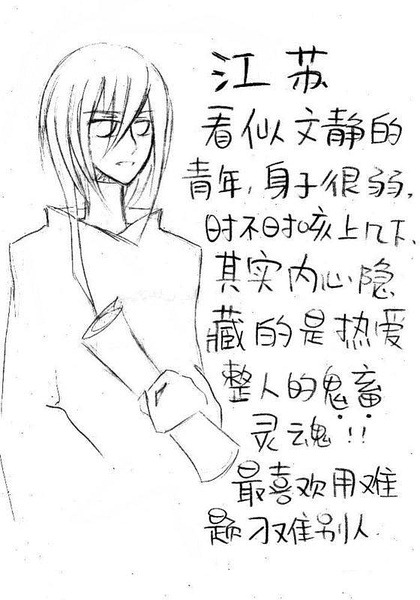
Jiangsu: Looks like a gentle and quiet youth, with a weak health and often coughs, but in fact deep down he loves to make others suffer!! He loves to use tough problems to create difficulties for others.
Jiangxi: Girl who does not talk much, and not good at communicating with others. Therefore often does things she does not want to do, and in a state of self-blame. Loves to keep fishes, has many china at home.
Jilin: Optimistic youth, bold personality but especially effective when dealing with women; likes to lend his helping hand when he sees injustice, but often gets into trouble; very loyal to his brothers, but slow to feel Heilongjiang’s tenderness.
Liaoning: General offensive of the Dongbie 3P party. Has firm and persistent personality like the steels. Loves erguotou (strong liquor), and has high alcohol tolerance. Sometimes thinks about the sad past. Takes care of two younger brothers; he is a tender and strong big uncle.
Macao: Girl with high vitality, very good at gambling. When loses she swears not to gamble again, but very easily set off fighting spirit, and forgets everything she said before.
Ningxia: a quiet man, don’t know what he is thinking about most of the time, his action is also unpredictable. Has specially feeling for pigs. Often carries different kinds of kitchen knives. Used to hang white fabrics at home and scared off Gansu.
Qinghai: Lazy young man looks lethargic and does not talk much all day long, therefore feels almost non- existence. Likes to stay home and likes to eat salty food, even the lake at home are salted. And another lake at home disappeared for no reason, everyone was puzzled.
Shanghai: Very bright and capable young man, fast paced, typical impatient hothead and absolute perfectionist. Does not allow himself or others to make mistakes (often troubled because of this) Seems to be surprisingly weak when taking off his glasses. Annoyed when called a “sissy”, loves to be elite and modern.
Shanxi: Loves money as much as she loves her life, often with a smiley face, but that is the weapon she lures the customers to buy her stuff. Carrying an abacus at all times, very business minded.
Sichuan: Arrogant young man with a rich family, has very bitter tongue and very competitive, somewhat narcissistic. Surprisingly tender to small animals. Recently he is healing wounds at home. His interest is cooking. Often plays MJ with little brother Chongqing, Hunan and Hubei.
Tianjin: Cute and confused little girl, originally already grew to be a maiden but because her brother Beijing was not happy about her height, she voluntarily shrank herself. Likes older brother very much; likes gentiana, and likes to give strange names to her home made buns. Sometimes her thoughts will automatically switch to high dimensional spaces.
Xinjiang: Young man with mood swings, very enthusiastic, but don’t know why recently likes to fight and separate the family… loves to dance and make wine and goes to everyone’s home to sell noodles and roasted lamb skewers.
Xizang (Tibet): Naturally gentle and lively girl, very tall and has an unhealthy obsession with cleanliness (mysophobia) therefore her home is always clean. Has a long dark history, so sometimes turns evil. Likes to sing and drink barley wine.
Yunnan: Natural young girl, very friendly to people, optimistic personality and has wide range of interests. Good at singing, dancing and art needlework, likes small animals. Her blood line is complicated and her pet phrase is “may become good friends”.
Zhejiang: a very weak girl, looks like an honor student, good at poetry and math (business), timid and cries a lot, loves to wear silk (chi-pao) mandarin gown and hold a small fan.


Beijing: Once had world’s great prestige of the imperial style but because of narcissism and not working hard he became weak and went back to his infant stage… Now grew to be a very arrogant child, working hard planning on “how to go back to being an adult”. Likes barbeque duck, recently troubled by a pile of old stuff at home.


In this next one, you can easily tell the artist is a Mainlander.

Taiwan: flirty girl (has a sex appeal), couple years ago had a fight with older brother then swam to the other side of the shore and went to Laomei (USA) family. Recently Laomei’s finical situation is not good so she starts to want to go back to big brother’s room…

09 October 2010

Problem China?

“Imprisoned Chinese dissident Liu Xiaobo on Friday October 8, 2010, won the Nobel Peace Prize. Obviously China is not happy about this, no news about the Nobel Peace Prize is reported on Chinese media; the name “Liu Xiaobo” along with “Nobel Peace Prize” became sensitive keywords which will give you empty search result on Baidu. The following article is probably the only thing you will find on China’s news sites.

(From Xinhua News) Foreign Ministry Spokesperson Ma Chaoxu said on October 8, the Nobel Committee to award the Nobel Peace Prize to Liu Xiaobo is completely going against the purpose of the award, and also is an insult to the Peace Prize.

On October 8th, the Nobel committed awarded the Nobel Peace Prize to Chinese dissident Liu Xiaobo. During the Q&A sessions Ma Chaoxu said, the Nobel Peace Prize should be awarded “to someone who promotes national harmony, international friendship and disarmament; someone who works hard on holding and promoting peace meetings”, which is Nobel’s wish. Liu Xiaobo is a criminal who has been sentenced to imprisonment for violating the Chinese Law, his behavior was going in the opposite direction of the purpose of the Nobel Peace Prize. The Nobel Committee awarded such person is completely going against the purpose of the award, and also is an insult to the Peace Prize.

When Ma Chaoxu answered the question of whether Liu Xiaobo winning the Nobel Peace Prize will affect Sino-Norway relations, he said, in the recent years, Sino-Norway relations have maintained sound development, which is beneficial to the interests of both countries and both countries’ people. However the Nobel Committee to award the Nobel Peace Prize to Liu Xiaobo is completely contradicting the purpose of the Nobel Peace Prize, and also will damage the Sino-Norway relations.”


In a symbolic victory for human rights in China, political dissident Liu Xiaobo has been awarded the Nobel Peace Prize "for his long and non-violent struggle for fundamental human rights in China”. Despite threats from the Chinese government, the Peace Prize Committee awarded him the prize along with $1.5 Million cash, both of which he is unable to claim. Liu created Charter 08, a manifesto signed by thousands of Chinese calling for political reform. In response, the Chinese government did what it always does in this situation. They arrested him, gave him an unfair trial, and threw him in jail for 11 years. After he was awarded the prize, his wife disappeared, likely by the hands of the CCP. China also summoned their ambassador to Norway and said the award would hurt Sino-Norwegian relations, despite that the Nobel Prize Institute is independent from the government. The last time China was this mad was in 1989 when the Dalai Lama got the prize, but that was 20 years ago and the Tiananmen Square Protests were taking place, putting China in poor position to lash back at Norway. That has apparently changed now, and I bet next time a Chinese dissident is awarded the prize, the diplomatic consequences will be more severe.

New York Times

Asia Sentinel